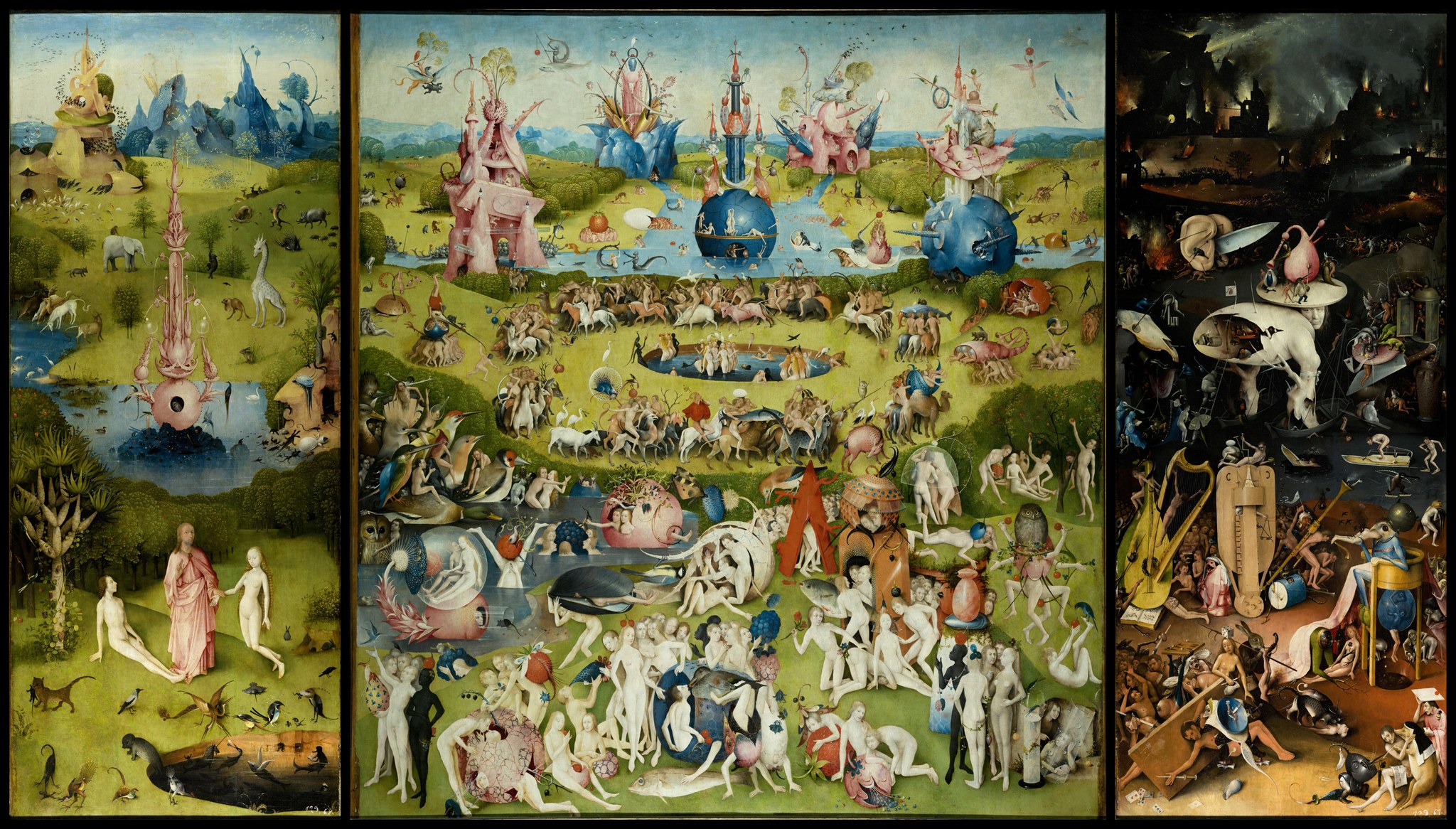
博斯《人间乐园》
Hieronymus Bosch · c. 1490–1500
《人间乐园》是耶罗尼米斯·博斯约 1490–1500 年画在橡木板上的三联祭坛画(展开 205.5 × 384.9 厘米),现藏马德里普拉多博物馆。Hush Gallery 为它单独建了一座围墙花园:砖墙、草地、一条砖径通向尽头的静水池,三联画立在水中的石座上,关着的时候是灰色的创世玻璃球,走近时两翼为你打开。在这里免费看人间乐园高清图,放大到伊甸园、乐园和地狱里每一个一指宽的细节。View Hieronymus Bosch's Garden of Earthly Delights in high resolution, free and without the crowd: one walled garden, one triptych standing in a still pool, closed on arrival and opening its shutters as you walk in. Zoom into Eden, the garden and Hell until a single owl's eye fills the screen — the Bosch Research and Conservation Project's own macro photography, panel by panel.
它是什么,以及为什么关着 · What it is, and why it arrives closed
一座橡木板上的三联祭坛画,约 1490 到 1500 年间画于斯海尔托亨博斯。1517 年它已经挂在布鲁塞尔拿骚伯爵亨德里克三世的宫里——一位路过的意大利枢机随员在日记里写下了它;1591 年腓力二世买下它,送进埃斯科里亚尔修道院;1939 年起在普拉多。它从来不是教堂的祭坛画,而是一件挂在宫殿里、给客人看的东西。 A triptych on oak, painted in 's-Hertogenbosch around 1490–1500. By 1517 it hung in the Brussels palace of Hendrik III of Nassau — a passing Italian cardinal's secretary wrote it up in his diary; in 1591 Philip II bought it and sent it to the Escorial; since 1939 it has been in the Prado. It was never an altarpiece in a church. It was a thing kept in a palace, to be shown to guests.
所以它有两张脸。关上,两翼的背面合成一只灰色的玻璃球:创世第三天,水陆刚分,还没有动物,也没有人;上帝小小地坐在左上角的云里,顶上两行拉丁文出自《诗篇》:「他说有,就有;他命立,就立。」打开,色彩才炸出来:左边是伊甸园,上帝把夏娃领到亚当面前;中间是一座挤满赤裸男女、巨大浆果和奇怪鸟兽的乐园;右边是夜里燃烧的地狱。 So it has two faces. Closed, the backs of the shutters make one grey glass globe: the third day of Creation, land just parted from water, no animals yet and no people; God sits small in the clouds at the top left, and two lines of Latin from the Psalms run across the top — "He spoke, and it was done; he commanded, and it stood fast." Open, the colour breaks out: Eden on the left, with God presenting Eve to Adam; in the middle a garden crowded with naked men and women, giant fruit and strange birds; on the right, Hell burning at night.
「人间乐园」不是博斯起的名字。1605 年埃斯科里亚尔的修士何塞·德·西古恩萨管它叫「草莓画」,并且替它辩护:别的画家画人的外表,这一幅画的是人的里面。它到底是一句警告,还是一场庆祝,五百年来吵到今天没有结论——因为博斯把证据画得太小了。 "The Garden of Earthly Delights" is not Bosch's title. In 1605 the Escorial's friar José de Sigüenza called it the strawberry painting, and defended it: other painters paint man as he looks on the outside, this one paints him as he is inside. Whether it is a warning or a celebration has been argued for five centuries without a verdict — because Bosch painted the evidence too small.
这里没有玻璃,也没有拦在两米外的绳子。沿着堤往前走,两扇门会为你打开;走到墙前再按 ↑,放大到你能看清一只猫头鹰的眼睛。 There is no glass here and no rope two metres out. Walk out along the jetty and the shutters open for you; at the wall press ↑ again, and zoom until you can see an owl's eye.
看这里 · Look here
- 上帝把夏娃领给亚当 · God presents Eve to Adam 左翼下方,一件粉红袍子的年轻人握着夏娃的手腕,把她领到刚坐起来的亚当面前——这是《创世记》里的「将她领到那人跟前」。博斯画的上帝是年轻的基督的样子,这在北方是常规。亚当的脚碰到了上帝的脚,眼睛却盯着夏娃。 Lower left wing: a young man in a rose-pink robe holds Eve by the wrist and brings her to Adam, who has just sat up — Genesis' "brought her unto the man." Bosch's God has the face of the young Christ, as northern painters usually did him. Adam's foot touches God's; his eyes are on Eve. 看亚当的脚趾和上帝的脚——挨着。 Adam's toes against God's foot — they touch.
- 泉眼里的猫头鹰 · The owl in the fountain 伊甸园中央这座粉红的生命之泉,像植物又像骨头。泉底那个圆洞里蹲着一只猫头鹰,正对着你看。猫头鹰在博斯的画里到处都是——中世纪把它当作黑暗里视物的鸟,既是智慧,也是异端和诱惑的记号。这是天堂里的第一个不祥。 The pink Fountain of Life at the centre of Eden — part plant, part bone. In the round hole at its foot an owl sits and looks straight at you. Owls are everywhere in Bosch: the bird that sees in the dark, standing for wisdom and just as readily for heresy and temptation. It is the first wrong note in Paradise. 圆洞里那两只眼睛。 The two eyes in the round hole.
- 一只画对了的长颈鹿 · A giraffe, drawn right 1500 年前后的荷兰没有人见过长颈鹿。这只画得出奇准确的长颈鹿,几乎肯定抄自西里亚科·德·皮齐科利 1440 年代在埃及画的写生,那本手稿在博斯的时代流传于欧洲。旁边的大象也同理。伊甸园里的动物是一场异域博物志。 Nobody in the Netherlands around 1500 had seen a giraffe. This oddly accurate one was almost certainly copied from a sketch Cyriacus of Ancona made in Egypt in the 1440s, circulating in manuscript in Bosch's day; so was the elephant nearby. Eden's animals are a natural history of the exotic. 斑纹和短短的角。 The patches and the short horns.
- 天堂脚下的黑水 · The dark pool under Paradise 伊甸园最下面是一潭黑水,里面爬着博斯自己发明的东西:一只三头鸟,一条长着翅膀的鱼,一只穿着修士斗篷、拿着书在读的鸭嘴怪。堕落还没发生,怪物已经在了。 At the very bottom of Eden is a dark pool with Bosch's own inventions crawling out of it: a three-headed bird, a fish with wings, a duck-billed thing in a monk's hood reading a book. The Fall hasn't happened yet. The monsters are already here. 戴兜帽读书的那只。 The hooded one, reading.
- 围着女人转的骑手 · The riders circling the women 中板正中央,一池子女人站在水里,头上顶着鸟和果子;外面一圈男人骑着马、猪、骆驼、鹿、豹和独角兽,逆时针绕着她们转,没有一个停下来。这是整幅画的机械:欲望绕着对象转圈。 Dead centre of the middle panel: a pool of women standing in the water, birds and fruit on their heads; around them a ring of men riding horses, pigs, camels, deer, a leopard, a unicorn, circling counter-clockwise, none of them stopping. It is the painting's engine — desire going round and round its object. 数一数有几种坐骑。 Count how many kinds of mount there are.
- 草莓画 · The strawberry painting 1605 年这幅画在埃斯科里亚尔的名字就是「草莓画」。中板上到处是比人还大的浆果——草莓、覆盆子、樱桃、黑莓——人们抱着它们、钻进去、把它们顶在头上。当时的一个说法:草莓香甜,但吃过就什么都没留下。 In 1605 the Escorial's name for this picture was the strawberry painting. Berries bigger than people are all over the middle panel — strawberries, raspberries, cherries, blackberries — people hug them, climb inside them, balance them on their heads. A proverb of the day: the strawberry is sweet, and once eaten leaves nothing behind. 浆果表面的每一粒籽都画了。 Every seed on the surface is painted.
- 泡泡里的情人 · The lovers in the bubble 一对男女被关在一只透明的球里,球从一朵巨大的花里长出来,泡在水上。一句荷兰谚语:幸福像玻璃,一碰就碎。博斯用一层透明的高光画出了玻璃——放大看,他只用了几笔。 A man and a woman shut inside a transparent sphere that grows out of a giant flower floating on the water. A Dutch proverb: happiness is like glass, it soon breaks. Bosch painted the glass with a few strokes of transparent highlight — zoom in and count them. 球面上的那道弧光。 The curved highlight on the sphere.
- 树人 · The Tree-Man 地狱的中心是一个人形的怪物:两条腿是枯树干,踩在两只船上;身体是一只裂开的蛋壳,里面开着一间酒馆;头上顶着一只风笛;他回过头来看着你,脸是所有博斯人物里最像肖像的一张——不少人相信那是博斯自己。维也纳有一张他单独画树人的素描。 At the centre of Hell stands a monster with a man's face: legs that are dead tree trunks standing in two boats, a body that is a broken eggshell with a tavern inside it, a bagpipe on his head. He looks back over his shoulder at you, and his face is the most portrait-like in all of Bosch — many believe it is Bosch himself. A drawing of the Tree-Man alone survives in Vienna. 他的眼睛正对着你。 His eyes are on you.
- 两只耳朵夹着一把刀 · A knife between two ears 一对巨大的人耳被一支箭串在一起,中间夹着一把刀,像一辆战车碾过底下的人群。刀身上刻着一个字母 M——有人说是刀匠的标记(斯海尔托亨博斯的刀具出名),有人说是 Mundus(世界),也有人说是敌基督的名字。 Two enormous human ears pierced by an arrow, a knife blade clamped between them, rolling over the crowd beneath like a war engine. A letter M is engraved on the blade — a cutler's mark, say some ('s-Hertogenbosch was famous for knives); Mundus, the world, say others; the Antichrist's initial, say a few. 刀身上的那个 M。 The M on the blade.
- 乐器地狱 · The musicians' Hell 地狱左下角是给音乐家的:一个人被钉在竖琴的弦上,一个被绑在鲁特琴的琴颈上,一个塞进了鼓里。旁边一个人趴着,屁股上写着一段乐谱——2014 年有人把它转写出来,真的能唱。 The lower left of Hell is for musicians: a man crucified on the strings of a harp, another lashed to the neck of a lute, a third stuffed into a drum. Beside them a man lies face down with a line of music written across his buttocks — in 2014 someone transcribed it, and it can be sung. 屁股上的五线谱。 The staff of music on the buttocks.
- 鸟头的王 · The bird-headed prince 一个鸟头的怪物坐在高高的便椅上,头上扣着一口锅,正把一个人整个吞下去;吞下去的从底下掉进一只透明的泡里,再落进坑中。中世纪地狱的老图式——魔鬼吃人再排出——博斯把它画成了一台机器。 A bird-headed monster on a high commode, a cauldron for a crown, swallowing a man whole; what he swallows drops through him into a transparent bubble and on down into the pit. The old medieval image of the devil eating and voiding the damned — Bosch has made it a machine. 被吞的那个人,脚还在外面。 The one being swallowed, feet still out.
- 夜里的城 · The city at night 地狱顶上是一座燃烧的城,火光从后面把黑夜照亮,人群在剪影里过桥。博斯十几岁时(1463 年)斯海尔托亨博斯烧掉了四千间房子——这可能是他记忆里的火。这是欧洲绘画里最早的夜景之一。 The top of Hell is a city on fire, the night lit from behind, crowds crossing a bridge in silhouette. When Bosch was a boy, in 1463, a fire destroyed four thousand houses in 's-Hertogenbosch — this may be the fire he remembered. It is one of the earliest night scenes in European painting. 桥上黑色的小人。 The black figures on the bridge.
- 戴头巾的猪 · The pig in a nun's veil 右下角,一只戴着修女头巾的猪搂着一个裸男,逼他在一份文书上签字——旁边一只戴着头盔的怪物举着墨水瓶。一般读作对教会兜售赎罪券、逼人立遗嘱捐产的讽刺。这是画里离你最近的一角。 Bottom right corner: a pig in a nun's veil embraces a naked man and presses him to sign a document, while a helmeted creature holds the inkwell. Usually read as a jab at the Church's trade in indulgences and deathbed bequests. It is the corner of the painting nearest to you. 猪的头巾和那张纸。 The pig's veil and the paper.